电阻测量会向传感器发送电源。负温度系数(NTC热敏电阻的阻值会随着温度升高而降低,因此即使在室温稳定的环境中,较高的测量电压也会导致读数发生偏移。将一颗玻璃珠留在原位,提高其激励电压,然后再恢复到初始电压。使用固定电阻重复上述步骤,以检查测量电路是否发生变化。
观察电压降和冷却曲线。实验旨在寻找与自加热一致的可逆模式。室温计和固定电阻有助于识别其他可能的解释。但它们无法确定珠子处的精确空气温度,也无法区分装置的每个影响因素。
识别热敏电阻及其工作状态
使用TDK Electronics玻璃封装的 B57560G1103G000 径向引线,型号为 G1560。标称阻值为 10 kΩ(25 °C),电阻容差为 ±2%。制造商标称工作温度为 3492 K。 B 该参数值涵盖 25 至 100 °C 的温度范围,概括了该温度区间内电阻曲线的斜率。在接近 25 °C 时,制造商提供的电阻/温度曲线 8307 显示电阻变化约为每开尔文 -3.9%。实验设计中会使用比值和该近似斜率。
G1560 数据手册显示,其在 25°C 时的最大功率为 50 mW,空气散热系数约为 1.3 mW/K。 耗散因数 是指在既定的热力条件下,温度每稳定升高一度所需的功率。同一张表格给出了空气中约 15 秒的冷却时间常数。时间常数描述了理想指数函数接近其最终值的速度。引线长度、支撑结构和空气流动都会影响此实验,因此请使用这些参数来规划实验步骤。
将传感器和两个电压表连接起来。
- 使用隔离的SIGLENT SPD3303X 通道 1 输出处于独立模式。输出禁用时,将通道正极连接到 VS+ 和否定 G0。 用一个 2.20 kΩ,1%,0.25 W 从 VS+ 到 MID将玻璃热敏电阻从 MID 连接到 G0。它有两个可互换的电线。断开其他供电通道,并将电流限制设置为 0.03 A。确认电源保持在恒压工作状态。
- 使用两节电池供电的 福禄克115 将数字万用表设置为固定量程 6.000 V 直流 (DC) 档。万用表 A 测量串联电阻两端的电压,红线接 VS+,黑线接 MID。万用表 B 测量热敏电阻两端的电压,红线接 MID,黑线接 G0。使用它们的电压和公共端 (COM) 插孔,并保持万用表悬空。将黑线连接在一起相当于将 MID 连接到 G0。
- 将两个引脚固定在绝缘支架上,使热敏电阻珠高于底座,并避免气流、手部接触和高温设备。每个热敏电阻引脚都应使用相同的支撑位置和接线方式。避免在玻璃密封处弯曲引脚。如果必须对引脚进行成型,请对其进行支撑并遵循制造商的引脚成型注意事项。将室温计放置在热敏电阻珠附近,并留出一定间隙,以防止热量传导至热敏电阻珠。使用温度计进行漂移检查。 10 kΩ,1%,0.25 W 仅在 MID 和 G0 处使用金属膜电阻器,用于单独的控制运行。
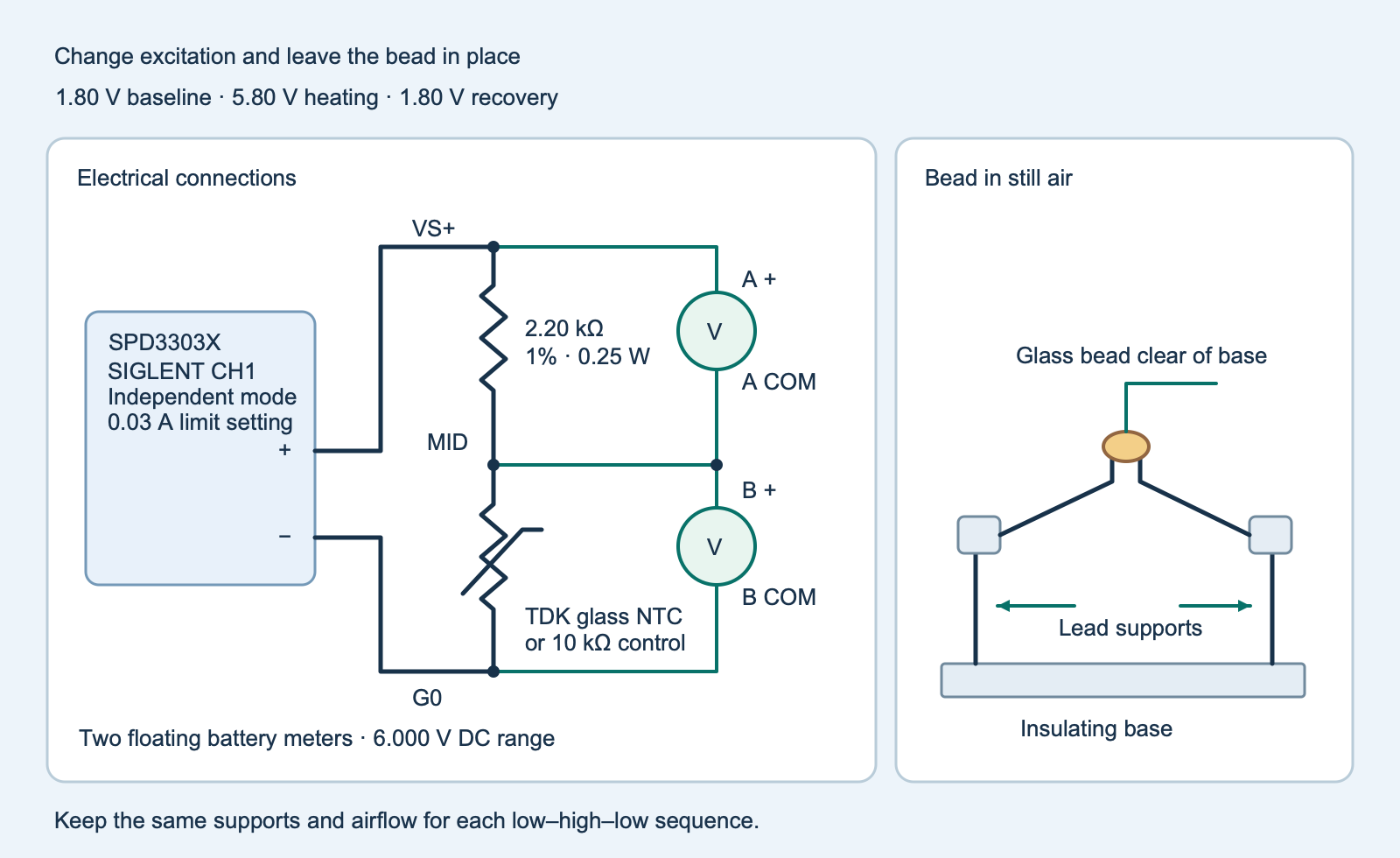
ntc-excitation-fixture.svg).在标称电阻为 10 kΩ 的室温下,1.80 V 电压会使微珠产生约 0.148 mA 的电流和 0.218 mW 的功耗。在 5.80 V 电压下,相同的电阻会产生 0.475 mA 的电流和 2.26 mW 的功耗。2.04 mW 的功耗差以及数据手册中的损耗因子表明,在标称的空气条件下,温度还会额外升高约 1.6 K。在接近 25 °C 时,这可能会导致电阻变化约 6%。这些是基于固定初始电阻的规划计算。实际电阻和功耗会随着微珠温度的升高而变化。在理想的串联模型中,即使使用最小的 1% 串联电阻,电路两端施加 6.00 V 的电压,器件的最大功耗也仅为 6.00² ÷ (4 × 2178) W,即约 4.13 mW。
每个设备记录一个低-高-低序列
- 设定电压为 1.80 V,设定完成后启动计时器。等待大约 80 秒时出现第一个延迟记录,然后在 80 秒、90 秒和 100 秒时分别记录两个电压值和附近的空气温度。检查两个电压值之和是否约为 1.80 V。整个测试过程中保持仪表量程一致。
- 保持磁珠位置不变。在不改变接线的情况下,将设定电压提高到 5.80 V。施加新电压后,启动下一个计时器。为了便于时间解读,设定电压的改变应在大约一秒或更短的时间内完成。分别记录大约 5、15、30 和 60 秒时的早期读数,以及 80、90 和 100 秒时的晚期读数。如果晚期读数比例持续漂移,请等待并增加读数。记录实际时间。
- 将电压恢复至 1.80 V,并以新的设置启动恢复计时器。分别在 3、6、10、15、20、30、45 和 60 秒时读取读数,然后在 80、90 和 100 秒时进行三次延迟读取。记录两个显示屏的读数并同时运行计时器,可以帮助您转录接近的读数对。如果步骤过慢或显示屏读数间隔过大,请运行终点比较。
--untimed重复上述步骤进行计时比较。 - 禁用输出,并将NTC热敏电阻替换为固定电阻,无需更改仪表、串联电阻或设定电压。重复上述三个阶段。控制器仅需要最后阶段的读数。使用相同的空气和设备设置。从……复制计划的行。 空白工作表(ZIP:
observations-blank.csv)使用实际秒数,并且只输入您运行中的值。
请将仪表保持在规定的精度条件下,对于福禄克仪表而言,这些条件包括 18–28 °C 的温度、高达 90% 的相对湿度以及校准后一年。程序会将测量电压总和的偏差控制在所选设定值的 0.10 V 以内,并将指示的环境温度偏差控制在 0.50 °C 以内。0.50 °C 的空气变化本身就可能导致室温附近 NTC 热敏电阻的读数偏移约 2%。请将环境温度偏差控制视为漂移检查。如果环境发生变化,请屏蔽热敏电阻,并重复上述步骤。
比较比率并估算功率
与 VS 串联电阻两端 RS 和 VD 估算整个设备的电流为 VS ÷ RS 以及设备功率 VD × VS ÷ RS使用电压比 q = VD ÷ VS 要跟随电阻变化,因为器件的标称电阻是 q × RS每一相都使用相同的串联电阻。
功率估算忽略了仪表的微小输入电流。对于比率范围,程序允许 Fluke 115 的电压不确定度为每次读数的 0.5% 加上两个 1 mV 计数,以及大于 10 MΩ 的输入电阻。考虑仪表负载时,流过设备的电流等于 VS ÷ RS + VS ÷ RA - VD ÷ RB第二项通过仪表 A 进入,第三项绕过设备,通过仪表 B 进入。这些范围涵盖了仪器型号。比较时保持相同的导线和触点。 四线电阻实验 显示感觉点移动时发生的变化。
分析仪在每个阶段至少使用三个在 80 秒或之后进行的读数,每个读数至少跨越 20 秒。工作表接受最长 180 秒的经过时间。它会检查最大和最小延迟比率的差异是否不超过其中位数的 1%。它会报告控制组的三个延迟区间是否存在重叠,以及热敏电阻的高温区间是否低于其两个重叠的低功率区间。具有稳定指示环境温度的可逆模式与激励加热一致。匹配的控制组和环境读数缩小了解释范围,并且微珠的直接空气温度和支撑温度仍然很重要。
可选的 半恢复组 该指标测量的是从热电阻比到恢复电阻比中间值所需的时间。它取最后一个采样电阻比明显低于中点区间,第一个采样电阻比明显高于中点区间。如果之后出现明显的反转,或者区间宽度超过 30 秒,则无法确定时间。这两个时间描述了低功率激励下的采样电阻响应。制造商的冷却时间常数采用不同的定义。
难题:两个设备都会随供电设置而变化。下一步该检查什么?
比较两个电压表的量程、极性和连接方式,并检查是否存在松动或偏移的感应点。在将热敏电阻的变化与加热联系起来之前,重复固定电阻序列。稳定的电阻控制是检查装置性能的一项指标。
运行完整工作表分析器
下载 实验 ZIP(ZIP: experiment-tests-v1.zip) 使用空白逗号分隔值 (CSV) 工作表、图表、完整程序和主机测试。运行 python3 ntc_self_heat.py observations.csv如果您单独测量了串联电阻,请加上 --series-ohms 然后是其在夹具公差范围内的测量值。该值会影响额定功率的计算。测试使用预设输入。请仅输入实验台上实际的空气和电压读数。
完整的 Python 工作表分析器
"""Compare thermistor excitation and recovery with a fixed-resistor control."""

import argparse
import csv
from dataclasses import dataclass
import json
import math
from pathlib import Path
from statistics import median
import sys

FIELDS = ("device", "phase", "time_s", "series_v", "device_v", "ambient_c")
DEVICES = ("ntc", "control")
PHASES = ("baseline", "heated", "recovery")
RAILS = {"baseline": 1.80, "heated": 5.80, "recovery": 1.80}
MIN_METER_INPUT_OHMS = 10_000_000.0
MAX_SERIES_OHMS = 2222.0
EPS = 1e-10


@dataclass(frozen=True)
class Reading:
    time_s: float
    series_v: float
    device_v: float
    ambient_c: float
    ratio: float
    ratio_low: float
    ratio_high: float
    inferred_power_mw: float


def bounded(raw, low, high, name):
    try:
        value = float(raw)
    except (TypeError, ValueError):
        raise ValueError(f"{name}: enter a number") from None
    if not math.isfinite(value) or not low <= value <= high:
        raise ValueError(f"{name}: expected {low:g} to {high:g}")
    return value


def meter_limits(volts):
    error = 0.005 * volts + 0.002
    return volts - error, volts + error


def reading(phase, values, series_ohms):
    elapsed = bounded(values[0], 0, 180, "time_s")
    series = bounded(values[1], 0.10, 2.5, "series_v")
    device = bounded(values[2], 0.50, 5.8, "device_v")
    ambient = bounded(values[3], 18, 28, "ambient_c")
    if abs(series + device - RAILS[phase]) > 0.10 + EPS:
        raise ValueError("voltage sum differs from the selected rail by more than 0.10 V")
    nominal_ratio = device / series
    if not 2.0 - EPS <= nominal_ratio <= 9.0 + EPS:
        raise ValueError("device-to-series voltage ratio outside the fixture's 2–9 screen")
    series_low, series_high = meter_limits(series)
    device_low, device_high = meter_limits(device)
    observed_low = device_low / series_high
    observed_high = device_high / series_low
    loading = MAX_SERIES_OHMS / MIN_METER_INPUT_OHMS
    ratio_low = observed_low / (1 + loading)
    ratio_high = observed_high / (1 - loading * observed_high)
    return Reading(elapsed, series, device, ambient, nominal_ratio, ratio_low, ratio_high,
                   1000 * device * series / series_ohms)


def read_worksheet(stream, series_ohms):
    rows = csv.reader(stream, strict=True)
    if tuple(next(rows, ())) != FIELDS:
        raise ValueError("use the exact worksheet headings")
    points = {(device, phase): [] for device in DEVICES for phase in PHASES}
    for row in rows:
        key = tuple(row[:2])
        if len(row) != len(FIELDS) or key not in points:
            raise ValueError(f"row {rows.line_num}: unexpected device, phase or field count")
        try:
            item = reading(key[1], row[2:], series_ohms)
            group = points[key]
            if group and item.time_s <= group[-1].time_s:
                raise ValueError("timestamps must increase within each device and phase")
            group.append(item)
        except ValueError as error:
            raise ValueError(f"row {rows.line_num}: {error}") from None
    return points


def late_summary(rows):
    late = [row for row in rows if row.time_s >= 80]
    if len(late) < 3 or late[-1].time_s - late[0].time_s < 20 - EPS:
        raise ValueError("each device and phase needs at least three late rows from 80 s spanning 20 s")
    middle = median(row.ratio for row in late)
    spread = max(row.ratio for row in late) - min(row.ratio for row in late)
    return {
        "rows": len(late),
        "time_span_s": [late[0].time_s, late[-1].time_s],
        "nominal_resistance_ratio": middle,
        "ratio_bounds": [median(row.ratio_low for row in late), median(row.ratio_high for row in late)],
        "nominal_device_power_mw": median(row.inferred_power_mw for row in late),
        "observed_ratio_spread_percent": 100 * spread / middle,
        "settled_by_one_percent_screen": spread <= 0.01 * middle + EPS,
    }


def overlap(intervals):
    return max(item[0] for item in intervals) <= min(item[1] for item in intervals) + EPS


def half_recovery(rows, heated, cooled):
    midpoint = [(h + c) / 2 for h, c in zip(heated, cooled)]
    first_above = next((i for i, row in enumerate(rows) if row.ratio_low > midpoint[1] + EPS), None)
    outcome = {"midpoint_ratio_interval": midpoint, "bracket_s": None}
    if first_above is None:
        return dict(outcome, status="no_sample_definitely_above")
    below_before = [row.time_s for row in rows[:first_above] if row.ratio_high < midpoint[0] - EPS]
    if not below_before:
        return dict(outcome, status="no_earlier_sample_definitely_below")
    if any(row.ratio_high < midpoint[0] - EPS for row in rows[first_above + 1:]):
        return dict(outcome, status="definite_reversal_after_crossing")
    high_time = rows[first_above].time_s
    low_time = below_before[-1]
    if high_time - low_time > 30 + EPS:
        return dict(outcome, status="sampling_bracket_wider_than_30_s")
    return dict(outcome, status="bracketed", bracket_s=[low_time, high_time])


def analyze(stream, series_ohms=2200.0, *, timed=True):
    series_ohms = bounded(series_ohms, 2178, 2222, "series resistance in ohms")
    points = read_worksheet(stream, series_ohms)
    summaries = {}
    for device, phase in points:
        try:
            summaries[device, phase] = late_summary(points[device, phase])
        except ValueError as error:
            raise ValueError(f"{device}/{phase}: {error}") from None
    all_ambient = [row.ambient_c for group in points.values() for row in group]
    ambient_span = [min(all_ambient), max(all_ambient)]
    stable_ambient = ambient_span[1] - ambient_span[0] <= 0.50 + EPS
    settled = all(summary["settled_by_one_percent_screen"] for summary in summaries.values())
    fixed = [summaries["control", phase]["ratio_bounds"] for phase in PHASES]
    control_overlap = overlap(fixed)
    before, hot, after = (summaries["ntc", phase]["ratio_bounds"] for phase in PHASES)
    recovered = overlap([before, after])
    reduction = hot[1] < min(before[0], after[0]) - EPS
    resolved = stable_ambient and settled and control_overlap and recovered and reduction
    timing = {"status": "timing_disabled_for_sequence", "bracket_s": None}
    if timed:
        timing = half_recovery(points["ntc", "recovery"], hot, after) if resolved else {
            "status": "endpoint_or_control_check_unresolved", "bracket_s": None}
    return {
        "assumed_series_ohms_for_nominal_power": series_ohms,
        "ambient_span_c": ambient_span,
        "ambient_screen_passed": stable_ambient,
        "all_late_ratio_spreads_within_one_percent": settled,
        "control_late_intervals_share_overlap": control_overlap,
        "ntc_baseline_and_recovered_intervals_overlap": recovered,
        "ntc_hot_interval_below_both_low_power_intervals": reduction,
        "reversible_pattern_consistent_with_self_heating": resolved,
        "half_recovery": timing,
        "late": {device: {phase: summaries[device, phase] for phase in PHASES} for device in DEVICES},
        "ntc_nominal_recovery_trace": [
            {"time_s": row.time_s, "ratio": row.ratio, "ratio_bounds": [row.ratio_low, row.ratio_high]}
            for row in points["ntc", "recovery"]
        ],
    }


def main():
    parser = argparse.ArgumentParser(description=__doc__)
    parser.add_argument("worksheet", type=Path)
    parser.add_argument("--series-ohms", type=float, default=2200.0)
    parser.add_argument("--untimed", action="store_true", help="skip the half-recovery timing bracket")
    options = parser.parse_args()
    try:
        if options.worksheet.stat().st_size > 100_000:
            raise ValueError("worksheet exceeds 100 kB")
        with options.worksheet.open(encoding="utf-8-sig", newline="") as stream:
            result = analyze(stream, options.series_ohms, timed=not options.untimed)
    except (OSError, ValueError, csv.Error) as error:
        print(f"Worksheet rejected: {error}", file=sys.stderr)
        return 2
    print(json.dumps(result, indent=2, allow_nan=False))
    return 0


if __name__ == "__main__":
    raise SystemExit(main())
有关使用低功率热敏电阻分压器来估算温度的另一种电路,请参见 双电阻温度计该夹具采用 TDK 的玻璃珠,可在有意改变测量功率的同时将夹具固定到位。
案例
- TDK电子 确切的 B57560G1103G000 可订购 和 G1560 2026年6月系列数据表.
- 吸虫, 110/113/114/115/117 user manual请参阅直流电压精度和输入特性表。
- SIGLENT, SPD3303X 产品规格请查看独立模式和频道设置。
下载完整阅读器文件(ZIP) 原始可编辑图纸、PNG 文件、工作表和代码 glass-ntc-excitation-self-heating完整的程序清单也已在上方列出。