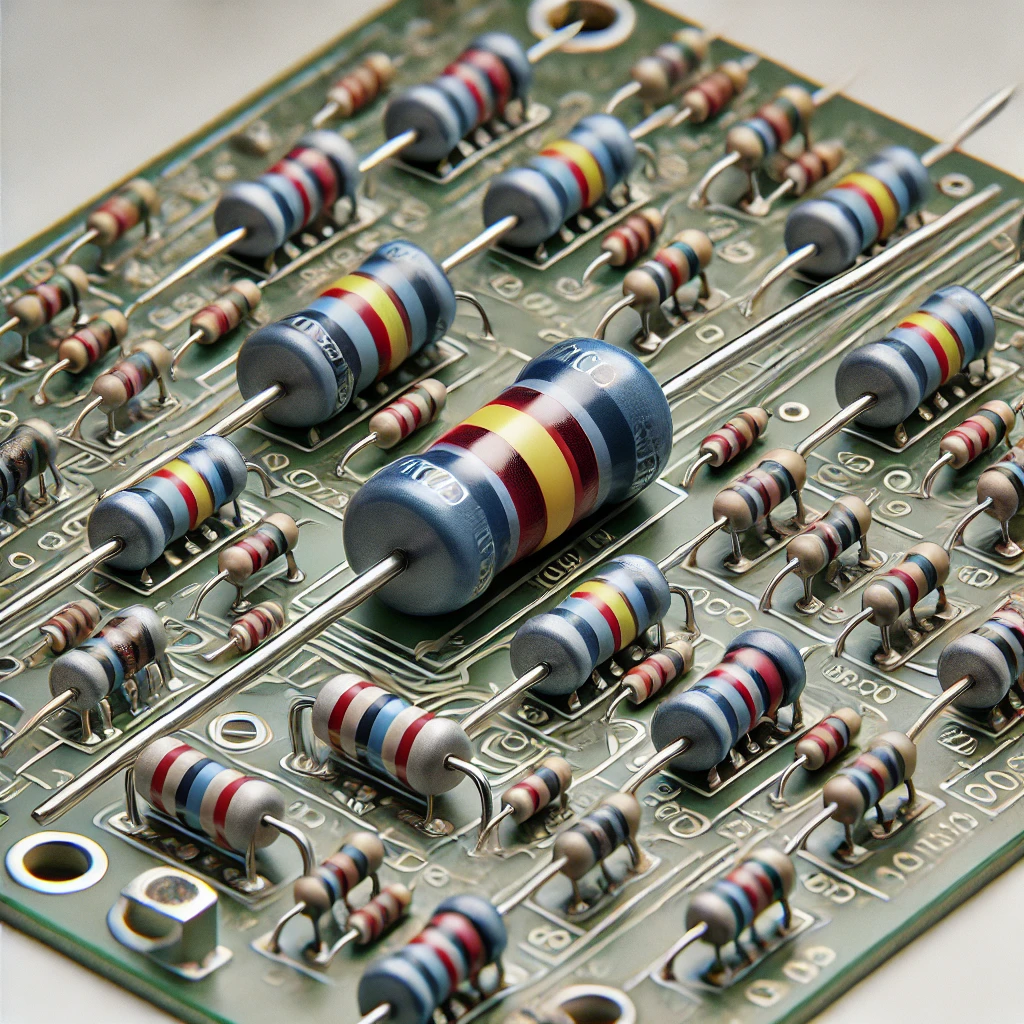
Resistors are one of the most fundamental components in electronics. They limit current, divide voltage, control signals, and adjust gain in circuits. Here are some practical applications with circuit examples:
1️⃣ Resistors in LED Current Limiting
📌 Application: Prevents an LED from burning out by limiting current.
📌 How It Works:
- Without a resistor, too much current flows, damaging the LED.
- The resistor controls the current, protecting the LED.
✅ Example Circuit:
   (Battery 9V)
        |
       [Resistor 470Ω]
        |
       (LED)
        |
       GND
- The resistor limits the current to around 20mA, safe for an LED.
🔧 Formula: R=Vsupply−VLEDILEDR = \frac{V_{supply} – V_{LED}}{I_{LED}}
2️⃣ Resistors in Voltage Dividers
📌 Application: Used to reduce voltage or create a reference voltage (e.g., sensor circuits, ADCs).
📌 How It Works:
- Two resistors in series split the input voltage.
- The output voltage depends on the ratio of the two resistors.
✅ Example Circuit (5V to 3.3V Converter):
   (5V Input)
        |
       [R1 = 1kΩ]
        |-------> (Vout = 3.3V)
       [R2 = 2kΩ]
        |
       GND
🔧 Formula: Vout=Vin×R2R1+R2V_{out} = V_{in} \times \frac{R2}{R1+R2}
Use Cases:
- Reducing voltage for microcontrollers (Arduino, ESP32).
- Creating a reference voltage for sensors.
3️⃣ Resistors in Pull-up and Pull-down Circuits
📌 Application: Ensures stable digital signals in microcontrollers and buttons.
📌 How It Works:
- A pull-up resistor keeps an input HIGH (1) when no signal is applied.
- A pull-down resistor keeps an input LOW (0) when no signal is applied.
✅ Example (Push Button with Pull-down Resistor)
   (5V) ------ [10kΩ Pull-up] ------ (Microcontroller Pin)
        |
      [Button]
        |
       GND
- When the button is pressed, the input goes LOW (0).
- When released, the resistor pulls it HIGH (1).
Use Cases:
- Debouncing mechanical switches.
- Ensuring stable logic levels in microcontrollers (Arduino, Raspberry Pi).
4️⃣ Resistors in Current Sensing (Shunt Resistors)
📌 Application: Measures current in power supply circuits, batteries, and motor controllers.
📌 How It Works:
- A low-value resistor (shunt) is placed in series.
- The voltage drop across it is proportional to the current.
✅ Example (Measuring Current with a 0.1Ω Resistor)
   (Battery +) ----[0.1Ω Resistor]---- (Load)
                         |
                      (Measure Voltage Drop)
🔧 Formula: I=VRI = \frac{V}{R}
Use Cases:
- Battery monitoring systems.
- Motor controllers (detect overload conditions).
5️⃣ Resistors in Timing Circuits (RC Circuits)
📌 Application: Used in timers, oscillators, and analog filters.
📌 How It Works:
- A resistor and capacitor set a time delay based on the charging time of the capacitor.
✅ Example (Simple Delay Circuit)
   (5V) ----[R = 1MΩ]---- (Capacitor 1µF) ---- GND
                                 |
                            (Output Signal)
🔧 Time Constant: τ=R×C\tau = R \times C (in seconds)
Use Cases:
- Blinking LED circuits.
- Timer circuits (555 timer IC).
6️⃣ Resistors in Audio Volume Control (Potentiometers)
📌 Application: Adjusts volume in speakers, amplifiers, and audio devices.
📌 How It Works:
- A variable resistor (potentiometer) controls the signal level.
✅ Example (Speaker Volume Control)
(Audio Signal) ---- [Potentiometer 10kΩ] ---- (Speaker)
- Turning the potentiometer adjusts the resistance, changing volume levels.
Use Cases:
- Guitar amplifiers.
- Home theater volume control.
7️⃣ Resistors in Temperature Sensors (NTC/PTC Thermistors)
📌 Application: Measures temperature in thermometers, HVAC systems, and microcontrollers.
📌 How It Works:
- NTC (Negative Temperature Coefficient): Resistance decreases as temperature increases.
- PTC (Positive Temperature Coefficient): Resistance increases as temperature increases.
✅ Example (Temperature Sensor with Arduino)
   (5V) ---- [NTC Thermistor] ---- (ADC Input)
                     |
                    GND
- The microcontroller reads voltage and converts it to temperature.
Use Cases:
- CPU temperature sensors.
- Thermostats and HVAC systems.
8️⃣ Resistors in Light Sensors (LDR Circuits)
📌 Application: Controls circuits based on light levels (e.g., automatic streetlights, night lamps).
📌 How It Works:
- A Light Dependent Resistor (LDR) changes resistance based on light.
- Combined with a voltage divider, it detects brightness changes.
✅ Example (Automatic Light Control)
   (5V) ---- [LDR] ---- (ADC Input of Microcontroller)
                     |
                   [10kΩ]
                     |
                    GND
- In darkness, resistance increases, turning on a light.
- In brightness, resistance decreases, turning it off.
Use Cases:
- Streetlights that turn on at night.
- Smartphones adjusting screen brightness.
💡 Summary of Resistor Applications
| Application | Function of Resistor |
|---|---|
| LED Current Limiting | Protects LEDs from high current |
| Voltage Dividers | Reduces voltage, creates reference voltages |
| Pull-up & Pull-down Resistors | Ensures stable digital signals |
| Current Sensing (Shunt Resistors) | Measures current in a circuit |
| Timing Circuits (RC Circuits) | Sets time delays for oscillators, timers |
| Audio Volume Control | Adjusts speaker/amplifier volume |
| Temperature Sensors (NTC/PTC Thermistors) | Measures temperature in circuits |
| Light Sensors (LDR Circuits) | Detects light levels for automation |