Build two short, disconnected 8P8C specimens. A meter will be able to find pin 1 at pin 1, pin 2 at pin 2, and so on in both. Only one specimen keeps the intended conductors together in each twist. The experiment makes that difference visible and gives you a repeatable way to record both observations.
Evidence scope. The pin maps and example output are calculated from the proposed wiring. The Python program was exercised on synthetic files. Build and measure your own specimens to collect readings. Keep both specimens isolated from all network equipment, Power over Ethernet (PoE), phone wiring and wall outlets.
What a continuity reading tells you
An 8P8C connector has eight positions and eight contacts. It is commonly called RJ45 in Ethernet hardware. A DC resistance reading between two contacts asks whether there is a low-resistance path. A twisted pair is two insulated conductors physically wound around each other. The pair may be hidden inside the jacket even when you can identify both ends of each conductor.
The T568A and T568B arrangements assign colors to the same four intended pin groups: 1–2, 3–6, 4–5 and 7–8. In a split pair, a logical pin group contains conductors from two different physical twists. Fluke Networks illustrates exactly this failure, including a case with correct end-to-end continuity. Closely twisting the two conductors of a differential signal helps them couple similarly to surrounding fields. Splitting the group changes that geometry and can increase crosstalk. This experiment records the wire map and construction. A pair-aware cable instrument measures separate electrical properties.
Parts and connections
- Four white Leviton GigaMax 5G108-RW5 Cat 5e UTP jacks. The jack labels identify contact numbers on both sides. Use the printed numbers as you work. An IDC is an insulation-displacement contact, which cuts through the wire insulation as the conductor is seated.
- Two roughly 0.5 m lengths of Belden 1583A U/UTP. Its four pairs use solid 24 AWG copper, with blue, orange, green and brown each twisted with a matching white-striped conductor. Use unspliced pieces.
- Two DFRobot FIT0848 passive 8P8C male-to-terminal breakouts, a digital multimeter with resistance mode and fine insulated probes, plus a 110-style punchdown tool. The breakout makes the contacts accessible. Its shell is outside the eight-contact experiment.
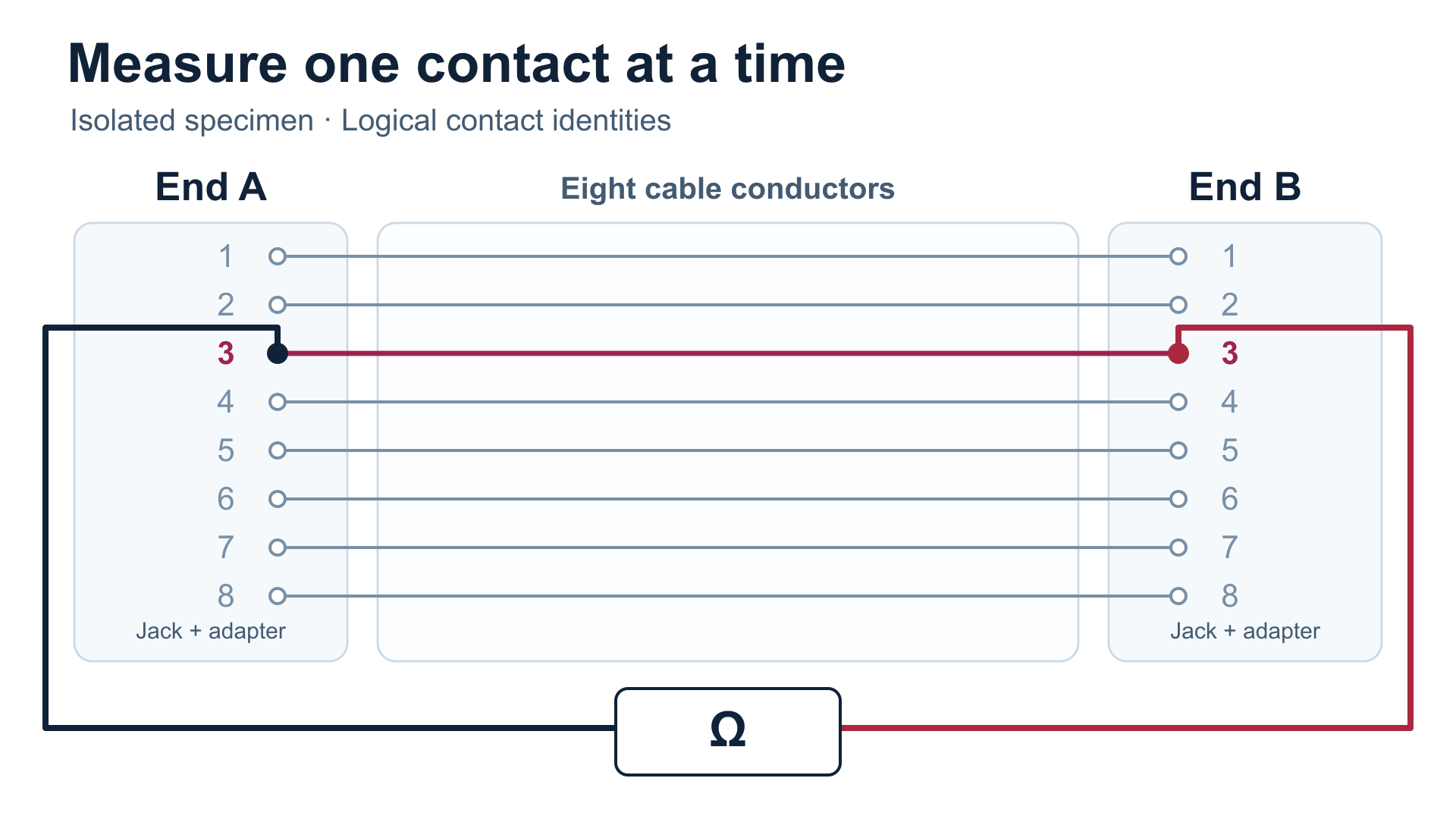
tricky-circuit-campaigns139-144/batch-014/packages/ethernet-split-pair-wire-map/fixture.svg)With each adapter loose and unplugged, confirm which terminal reaches each plug contact. DFRobot’s specification lists terminal sequence 3, 4, 5, 2, 1, 6, 7, 8. The product image shows wire numbers in a different order. Verify the mapping on each unit with the meter and fine probes without bridging adjacent contacts. Label the terminals by the connector contacts they actually reach. All numbers in the figures, table and CSV refer to those verified contact identities. Check that the loose terminals have no unintended low-resistance connections. Stop if you cannot identify all eight contacts reliably.
Label both ends A and B. Follow Leviton’s jacket removal, 110 punchdown and dust cap directions. Keep pair twisting to within ½ in (about 13 mm) of the contact where the routing permits, and keep the jacket against the rear as shown in the instructions. Trace each stripe while the twist is visible. When a stripe or mate is uncertain, record it as unknown. The intentionally faulty specimen is a teaching prop. Mark it SPLIT — DO NOT USE on both ends.
Make the two specimens
The table applies at both ends of each specimen. The 5G108’s IDC slots are physically staggered. Find the printed pin number for each row before seating a conductor. The split specimen exchanges the white/green and white/blue conductors on pins 3 and 5, at both ends. The solid blue and solid green wires stay on pins 4 and 6.
| Pin | Control at A and B | Split at A and B |
|---|---|---|
| 1 | WO (white/orange) | WO |
| 2 | O (orange) | O |
| 3 | WG (white/green) | WBL (white/blue) |
| 4 | BL (blue) | BL |
| 5 | WBL (white/blue) | WG (white/green) |
| 6 | G (green) | G |
| 7 | WBR (white/brown) | WBR |
| 8 | BR (brown) | BR |
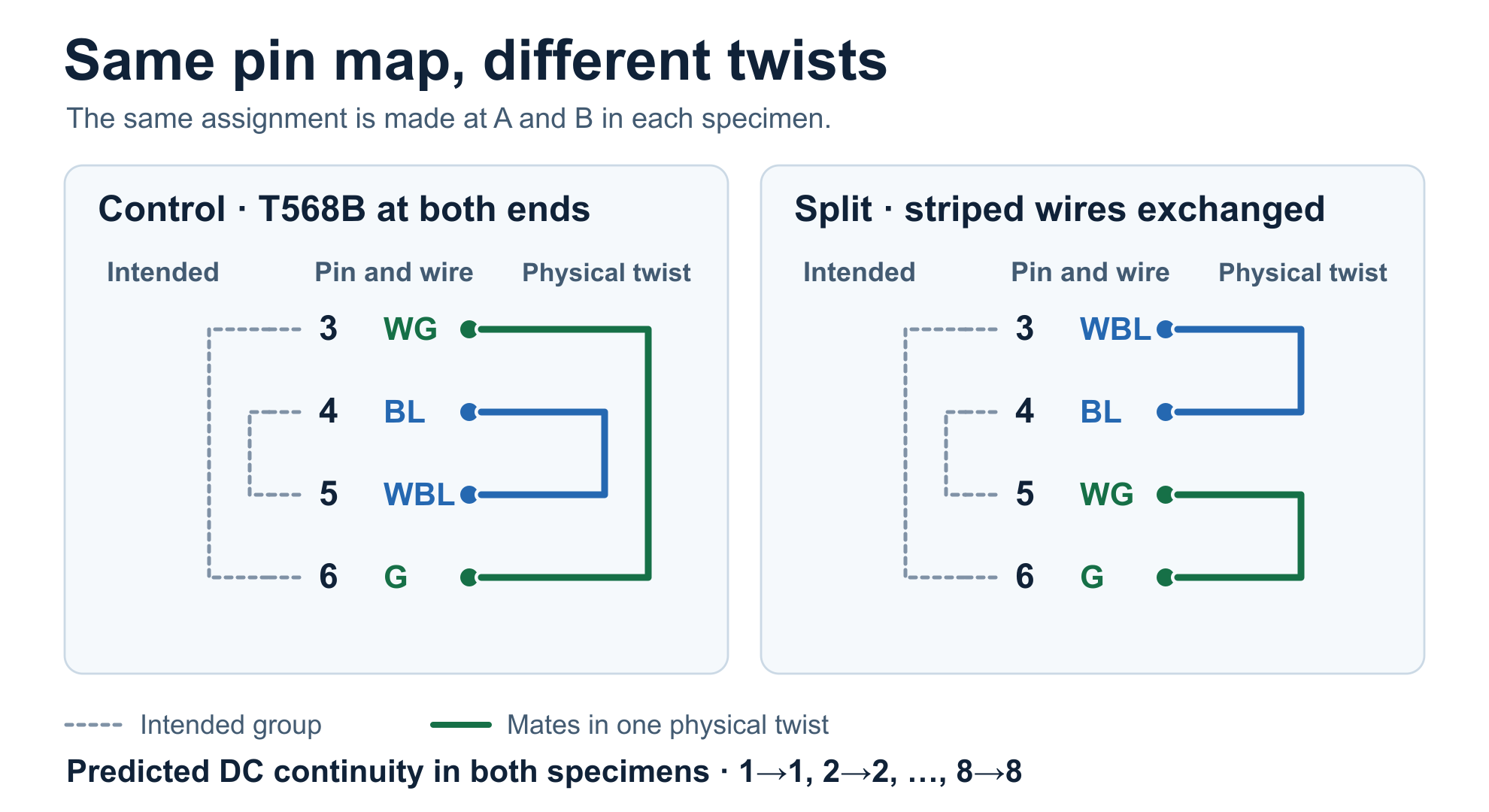
tricky-circuit-campaigns139-144/batch-014/packages/ethernet-split-pair-wire-map/pair-geometry.svg)For an unspliced specimen, a conductor gives one connection from its A contact to its B contact. In the control, white/green connects 3 to 3. In the split specimen, white/blue takes its place at both ends, so 3 still connects to 3. The same reasoning holds for pin 5. In the control, green occupies 3–6 and blue 4–5. In the split specimen, blue occupies 3–4 and green 5–6. Each intended group now draws one wire from each physical pair.
Measure a full cross-end matrix
- Put the meter leads in the common and resistance jacks. Confirm that touching the tips gives a stable low value and separating them gives the meter’s open indication. Use the same meter and range for both pieces. The short cable’s published maximum conductor resistance, 93.8 Ω/km, corresponds to about 0.047 Ω for one 0.5 m conductor before jacks and probes. A typical handheld meter also sees the leads and contacts.
- Record the conductor identities before closing the caps. Add the adapters. Hold the common probe on contact 1 at A and try contacts 1 through 8 at B, one at a time. Repeat for all eight A contacts, giving 64 checks per specimen. Use a stable reading of at most 10 Ω as this fixture’s local continuity cutoff. A stable open indication means no link in this measurement. Reseat and repeat if the reading is unstable or finite above the cutoff. Resolve it before reducing it to a yes/no entry.
- On a copy of the blank CSV, put the B matches in the
remote_pinscell for each A row. Record3for one match,3|5for more than one, or-when none of the eight contacts gives continuity. Leave unfinished entries blank until measured. The color columns describe the physical conductor on the same numbered contact at each end, regardless of which remote pin matches. Use?for an uncertain color. - Repeat the same procedure with the other specimen. A clean cross-end matrix is limited to the 64 measured combinations. For a separate same-end fault check, disconnect the probes from the far end and sweep the 28 unique contact pairs on A, then on B, with the opposite adapter still floating. The CSV represents cross-end observations only.
The cable overview gives examples of how conductor construction varies by application. The short RS-485 lesson gives a separate example of using a physical twist for a differential signal. Cable overview · Differential RS-485 bench link
Run the complete wire-map analyzer
Use Python 3.9 or later. The archive contains the program, both synthetic specimens, the blank worksheet, both original diagrams and executable host tests. Run the shipped examples first, then give your own complete worksheet a different filename. The provenance switch records your choice in the JSON.
python3 wire_map.py --kind synthetic synthetic-control.csv
python3 wire_map.py --kind synthetic synthetic-split.csv
python3 wire_map.py --kind observed control-readings.csv
The two synthetic examples produce continuity: straight with identical remote_pins. The control gives pair_evidence: paired and T568B at both ends. The deliberate swap gives pair_evidence: split and lists both affected groups at each end. A bijective map other than identity is one_to_one_nonstraight. Zero or several matches in a row, or reusing a remote pin, gives open_or_multilink. The program accepts a detected wiring fault as an observation and reserves exit status 2 for bad input.
A known split remains visible when another group is unknown. With no known split, unknown groups make the pair result incomplete. For a one-to-one map the tool checks color identity along each link where both colors are known. If A3 measures through to B3 but they have different colors, recheck both adapter labels and observations before interpreting the pair report. A single uninterrupted conductor should keep its identity. The reported colors come from your visual observations.
#!/usr/bin/env python3
"""Compare cross-end continuity and visible twist membership in an 8P8C fixture."""
import argparse
import csv
import json
from pathlib import Path

PINS = tuple(range(1, 9))
GROUPS = ((1, 2), (3, 6), (4, 5), (7, 8))
COLORS = ('WO', 'O', 'WG', 'G', 'WBL', 'BL', 'WBR', 'BR')
PAIR = dict(zip(COLORS, ('orange', 'orange', 'green', 'green', 'blue', 'blue', 'brown', 'brown')))
T568A = ('WG', 'G', 'WO', 'BL', 'WBL', 'O', 'WBR', 'BR')
T568B = ('WO', 'O', 'WG', 'BL', 'WBL', 'G', 'WBR', 'BR')
HEADER = ['pin', 'remote_pins', 'a_color', 'b_color']
PIN_TEXT = tuple(map(str, PINS))


def read_matrix(path):
    """Read complete thresholded observations. A blank is an unfinished reading."""
    remotes, a_colors, b_colors = {}, {}, {}
    with path.open(encoding='utf-8-sig', newline='') as stream:
        rows = csv.reader(stream, strict=True)
        if next(rows, None) != HEADER:
            raise ValueError('expected header: ' + ','.join(HEADER))
        for row in rows:
            if len(row) != len(HEADER):
                raise ValueError('every data row must have four fields')
            pin_text, remote_text, a_color, b_color = (value.strip() for value in row)
            if pin_text not in PIN_TEXT:
                raise ValueError(f'pin must be 1 through 8 at line {rows.line_num}')
            pin = int(pin_text)
            if pin in remotes:
                raise ValueError(f'duplicate pin {pin}')
            items = [] if remote_text == '-' else remote_text.split('|')
            if any(item not in PIN_TEXT for item in items):
                raise ValueError(f'pin {pin}: remote pins must be 1–8 separated by |, or - for none')
            if len(items) != len(set(items)):
                raise ValueError(f'pin {pin}: repeated remote pin')
            if any(color not in (*COLORS, '?') for color in (a_color, b_color)):
                raise ValueError(f'pin {pin}: color must be one of {", ".join(COLORS)} or ?')
            remotes[pin] = sorted(map(int, items))
            a_colors[pin] = a_color
            b_colors[pin] = b_color
    if len(remotes) != len(PINS):
        raise ValueError('the matrix must contain all eight pins')
    for label, colors in (('A', a_colors), ('B', b_colors)):
        known = [color for color in colors.values() if color != '?']
        if len(known) != len(set(known)):
            raise ValueError(f'end {label}: repeated known color')
    return remotes, a_colors, b_colors


def end_wiring(colors):
    sequence = tuple(colors[pin] for pin in PINS)
    if '?' in sequence:
        return 'unknown'
    if sequence == T568A:
        return 'T568A'
    if sequence == T568B:
        return 'T568B'
    return 'other'


def inspect_pairs(colors):
    result = []
    for pair in GROUPS:
        a, b = (colors[pin] for pin in pair)
        if '?' in (a, b):
            status = 'unknown'
        else:
            status = 'paired' if PAIR[a] == PAIR[b] else 'split'
        result.append({'pins': list(pair), 'colors': [a, b], 'status': status})
    return result


def analyze(remotes, a_colors, b_colors, kind):
    destinations = [dst for pin in PINS for dst in remotes[pin]]
    one_to_one = (all(len(remotes[pin]) == 1 for pin in PINS)
                  and sorted(destinations) == list(PINS))
    if not one_to_one:
        continuity = 'open_or_multilink'
    elif destinations == list(PINS):
        continuity = 'straight'
    else:
        continuity = 'one_to_one_nonstraight'

    pairs = {'A': inspect_pairs(a_colors), 'B': inspect_pairs(b_colors)}
    statuses = {row['status'] for end in pairs.values() for row in end}
    pair_evidence = 'split' if 'split' in statuses else (
        'incomplete' if 'unknown' in statuses else 'paired')

    compared = 0
    mismatches = []
    for a_pin, b_pin in zip(PINS, destinations) if one_to_one else ():
        a_color, b_color = a_colors[a_pin], b_colors[b_pin]
        if '?' in (a_color, b_color):
            continue
        compared += 1
        if a_color != b_color:
            mismatches.append({'a_pin': a_pin, 'b_pin': b_pin, 'a_color': a_color, 'b_color': b_color})
    if not one_to_one:
        color_trace = 'not_evaluated'
    elif mismatches:
        color_trace = 'inconsistent'
    else:
        color_trace = 'consistent' if compared == len(PINS) else 'incomplete'

    return {
        'kind': kind,
        'continuity': continuity,
        'remote_pins': {str(pin): remotes[pin] for pin in PINS},
        'end_wiring': {'A': end_wiring(a_colors), 'B': end_wiring(b_colors)},
        'pair_status': pairs,
        'pair_evidence': pair_evidence,
        'color_trace': color_trace,
        'colors_compared_across_ends': compared,
        'color_mismatches': mismatches,
        'scope': 'One disconnected, unspliced specimen. No link performance or certification claim.',
    }


def main():
    parser = argparse.ArgumentParser(description=__doc__)
    parser.add_argument('--kind', choices=('synthetic', 'observed'), required=True,
                        help='operator-supplied provenance for the CSV')
    parser.add_argument('csv', type=Path, help='complete wire-map worksheet')
    args = parser.parse_args()
    try:
        result = analyze(*read_matrix(args.csv), args.kind)
    except (OSError, UnicodeError, csv.Error, ValueError) as exc:
        parser.error(str(exc))
    print(json.dumps(result, indent=2))


if __name__ == '__main__':
    main()
Blank worksheet (ZIP; file: tricky-circuit-campaigns139-144/batch-014/packages/ethernet-split-pair-wire-map/observations-blank.csv) · Synthetic control (ZIP; file: tricky-circuit-campaigns139-144/batch-014/packages/ethernet-split-pair-wire-map/synthetic-control.csv) · Synthetic split pair (ZIP; file: tricky-circuit-campaigns139-144/batch-014/packages/ethernet-split-pair-wire-map/synthetic-split.csv) · Complete experiment and tests ZIP (ZIP; file: tricky-circuit-campaigns139-144/batch-014/packages/ethernet-split-pair-wire-map/experiment-tests-v1.zip)
Challenge
Suppose you exchange the white/green and white/blue conductors at end B only. Which A rows change? Which end has the split pair?
Show the answer
A3 now reaches B5 on white/green and A5 reaches B3 on white/blue. All other links stay in place. The map remains one-to-one but becomes nonstraight. A is still paired. At B, intended groups 3–6 and 4–5 mix the blue and green twists.
Primary references
- Leviton 5G108 instructions, English installation steps, pin labels and T568A/B Table 1.
- Leviton 5G108-xx5 specification, October 2023, exact white 5G108-RW5 on page 2.
- Belden 1583A technical data, conductor construction, pair colors and DC resistance on page 1.
- DFRobot FIT0848, passive male terminal adapter and product photographs.
- Fluke Networks, Split Pair Identification, and MicroScanner2 twisted-pair results, Figure 7 and the continuity limitation.
Download the complete reader files (ZIP): full programs, blank observation worksheets, original editable SVG/PNG diagrams and selected support files for ethernet-split-pair-wire-map. Inline main programs remain complete; this download is supplementary.