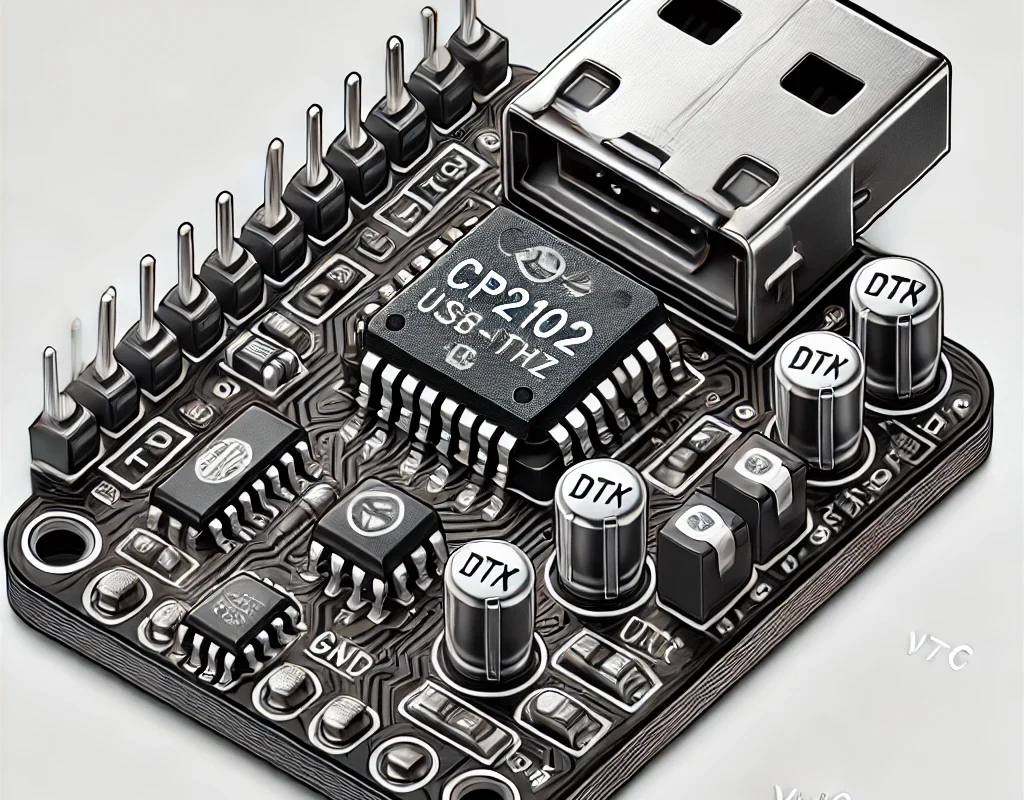
The CP2102 is a USB-to-serial (UART) bridge developed by Silicon Labs. It is widely used for connecting microcontrollers (Arduino, ESP8266, STM32) and other serial-based devices to a computer via USB. It provides a simple, low-cost way to enable serial communication with plug-and-play drivers for most operating systems.
🔹 1. What is CP2102?
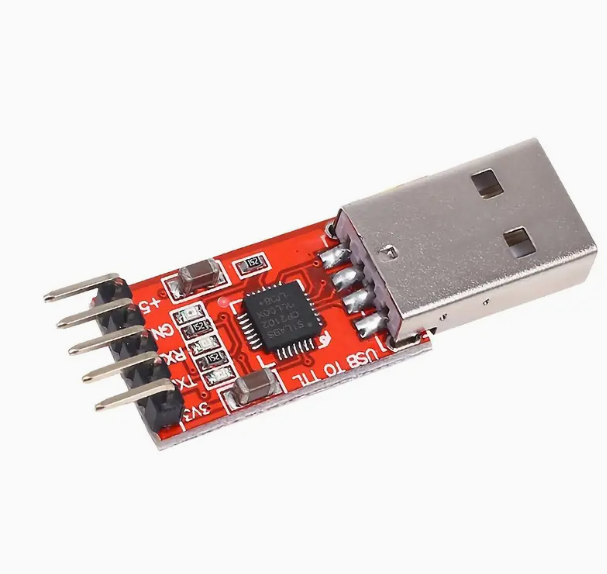
- The CP2102 is an integrated USB-to-UART converter.
- It allows a computer to communicate with microcontrollers or embedded systems over a serial interface (UART).
- Unlike CH340G, it has native driver support in Windows, macOS, and Linux.
- Used in ESP8266/ESP32, STM32, and many Arduino clones.
🔹 2. Features of CP2102
| Feature | Description |
|---|---|
| USB Interface | USB 2.0 (Full-Speed 12Mbps) |
| Baud Rate | Supports 300bps to 3Mbps |
| Voltage Support | 3.3V / 5V Logic |
| Hardware Flow Control | Supports RTS/CTS, DTR/DSR |
| EEPROM Support | No external EEPROM required |
| Power Consumption | Low-power operation |
| Driver Support | Windows, macOS, Linux, Android (Plug & Play) |
| Package Type | QFN-28 (Surface Mount) |
📌 Note: CP2102 has better driver support than CH340G and is widely used in embedded applications.
🔹 3. CP2102 Pinout & Connections
The CP2102 module usually comes in a small breakout board with the following pins:
| Pin | Function | Connection |
|---|---|---|
| VCC | Power (3.3V or 5V) | Connect to 3.3V or 5V |
| GND | Ground | Common ground |
| TXD | Transmit Data | Connect to RX of microcontroller |
| RXD | Receive Data | Connect to TX of microcontroller |
| DTR | Data Terminal Ready | Used for auto-reset on Arduino/ESP8266 |
| RTS | Request to Send | Used for flow control |
| CTS | Clear to Send | Used for flow control |
📌 Most CP2102 breakout boards have a jumper to select between 3.3V and 5V operation.
🔹 4. How to Connect CP2102 to Arduino or ESP8266
🛠 Required Components
- CP2102 USB-to-Serial Module
- ESP8266 or ATmega328P
- 100nF Capacitor (for Auto-Reset)
- Jumper Wires
- Breadboard
🛠 Wiring Diagram
| CP2102 Pin | ESP8266 / Arduino Pin |
|---|---|
| VCC (3.3V) → 3.3V | (ESP8266) |
| VCC (5V) → 5V | (Arduino) |
| GND → GND | Common ground |
| TXD → RX | Receive Data |
| RXD → TX | Transmit Data |
| DTR → RESET (via 100nF capacitor) | Auto-Reset |
📌 Use the Arduino IDE to upload code via CP2102 by selecting “Arduino Uno” or “ESP8266” as the board.
🔹 5. Installing CP2102 Drivers
✅ Windows
- Download CP2102 driver from Silicon Labs.
- Install the driver (
CP210xVCPInstaller_x64.exe). - Plug in the CP2102 module and check Device Manager (
Win + X → Device Manager → Ports). - If installed correctly, it will show as “Silicon Labs CP210x USB to UART Bridge”.
✅ macOS
- MacOS usually detects CP2102 natively.
- If not, download the driver from Silicon Labs.
- Install and check:bashCopyEdit
ls /dev/tty.* - If you see something like
/dev/tty.SLAB_USBtoUART, the driver is working.
✅ Linux
- CP2102 is natively supported in most Linux distributions.
- Check if it’s recognized:bashCopyEdit
lsusb | grep CP210 - If needed, install drivers:bashCopyEdit
sudo apt update sudo apt install cp210x-dkms
🔹 6. Common Issues & Fixes
| Issue | Possible Cause | Solution |
|---|---|---|
| Device not detected | Missing driver | Install the correct CP2102 driver |
| Wrong COM port | Multiple USB devices connected | Check COM port in Device Manager |
| Upload fails | DTR pin not connected | Ensure DTR → RESET via 100nF capacitor |
| Garbled Serial Output | Wrong baud rate | Set correct baud rate (e.g., 9600, 115200) |
🔹 7. CP2102 vs. Other USB-to-Serial Converters
| Feature | CP2102 | CH340G | FT232RL (FTDI) |
|---|---|---|---|
| Cost | Medium (~$5) | Low (~$1-2) | High (~$10) |
| Speed | 3 Mbps | 2 Mbps | 3 Mbps |
| Voltage Levels | 3.3V / 5V | 3.3V / 5V | 3.3V / 5V |
| Driver Issues | Native Support | Manual Install Needed | Native Support |
| Ease of Use | Easy | Moderate | Easy |
📌 Verdict: CP2102 is a great balance between cost, performance, and driver support, making it better than CH340G but cheaper than FTDI.
🎯 Conclusion
- CP2102 is a USB-to-serial UART chip widely used for Arduino, ESP8266, STM32, and other microcontrollers.
- It offers plug-and-play driver support for Windows, macOS, and Linux.
- Supports high-speed serial communication (up to 3Mbps).
- Works with both 3.3V and 5V logic levels.
- Better than CH340G in terms of compatibility and reliability.