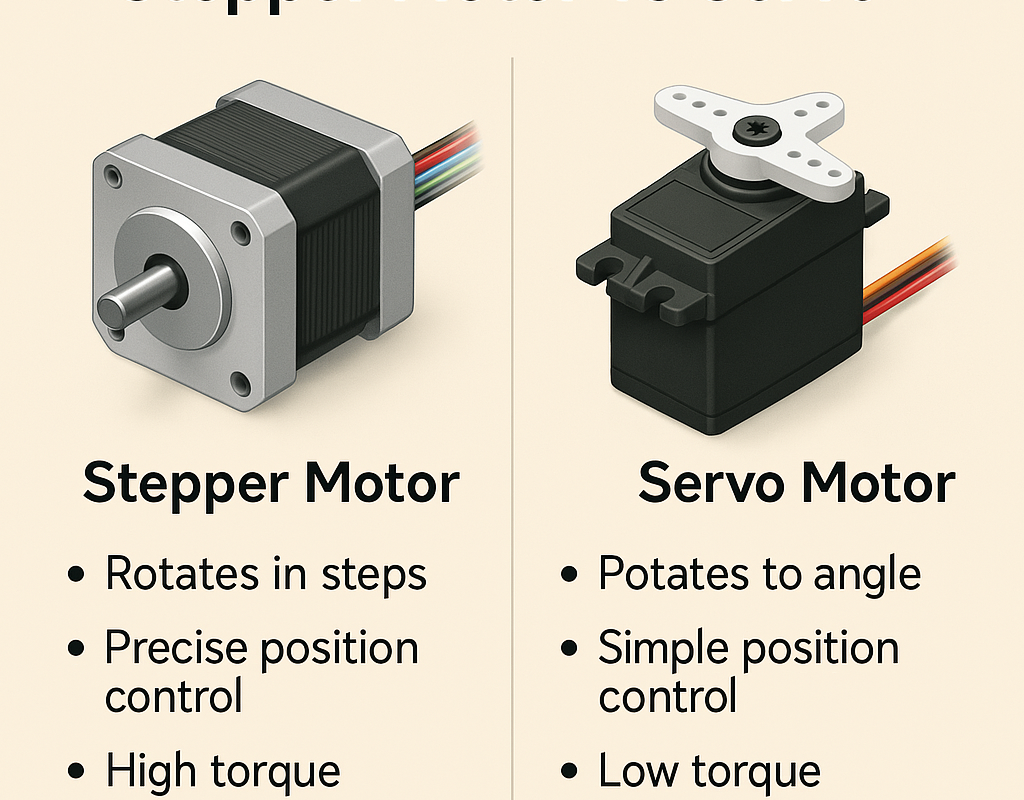
Choosing between a stepper motor and a servo motor is a big decision in robotics and motion control. Both have unique strengths, and your project goals will decide the winner! Let’s break it down. ⚖️🚀
🏋️ Stepper Motors
How they work:
- Rotate in precise steps (typically 1.8° per step)
- Open-loop control (no feedback needed)
Pros:
- Great precision and repeatability
- Easy to control with microcontrollers
- Ideal for 3D printers, CNC, plotters
Cons:
- Can lose steps under heavy load
- No position feedback (unless external encoder used)
- Vibrate at certain speeds
📈 Servo Motors
How they work:
- Controlled by a PWM signal
- Use internal feedback to reach and maintain position
Pros:
- Smooth and fast movement
- Precise positioning with feedback
- Strong torque at high speed
Cons:
- More complex electronics
- More expensive than steppers
- Limited rotation (typically 0° to 180° for hobby servos)
🧠 Use Case Comparison
| Feature | Stepper Motor | Servo Motor |
|---|---|---|
| Precision (angle) | High | Medium (hobby), High (industrial) |
| Feedback | No (open loop) | Yes (closed loop) |
| Torque | Good at low speeds | Great at high speeds |
| Cost | Affordable | Mid to high |
| Complexity | Easy to use | Needs PWM or libraries |
| Range of Motion | 360° or more | Limited (unless using continuous servo) |
🤖 Which One Should You Use?
Choose Stepper Motor if:
- You need precise control over rotation
- You’re building a 3D printer, slider, CNC, or rotating platform
- You want something budget-friendly
Choose Servo Motor if:
- You need feedback and accurate positioning
- You’re building a robot arm, RC car steering, or pan/tilt system
- You want smooth and fast movement
🔥 TL;DR
- Steppers = precision, no feedback, full rotation, simple
- Servos = feedback, fast motion, limited angle, more flexible
Both are awesome — just pick the one that fits your bot’s mission! 💪🚒