1️⃣ Accuracy and Range
DHT11:
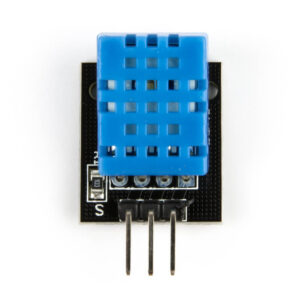
- Temperature Range: 0°C to 50°C with a precision of ±2°C.
- Humidity Range: 20% to 80% RH with a precision of ±5% RH.
- Response Time: 1 Hz (one reading every second).
DHT22 (also known as AM2302):
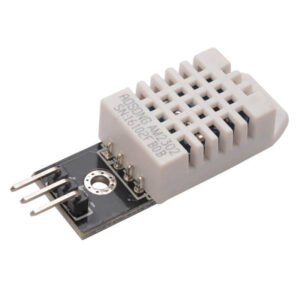
- Temperature Range: -40°C to 80°C with a precision of ±0.5°C.
- Humidity Range: 0% to 100% RH with a precision of ±2% to 5% RH.
- Response Time: 0.5 Hz (one reading every 2 seconds).
2️⃣ Build Quality and Durability
DHT11:
- Sensor Type: Resistive humidity measurement and a thermistor for temperature, which can be less durable and slower to respond.
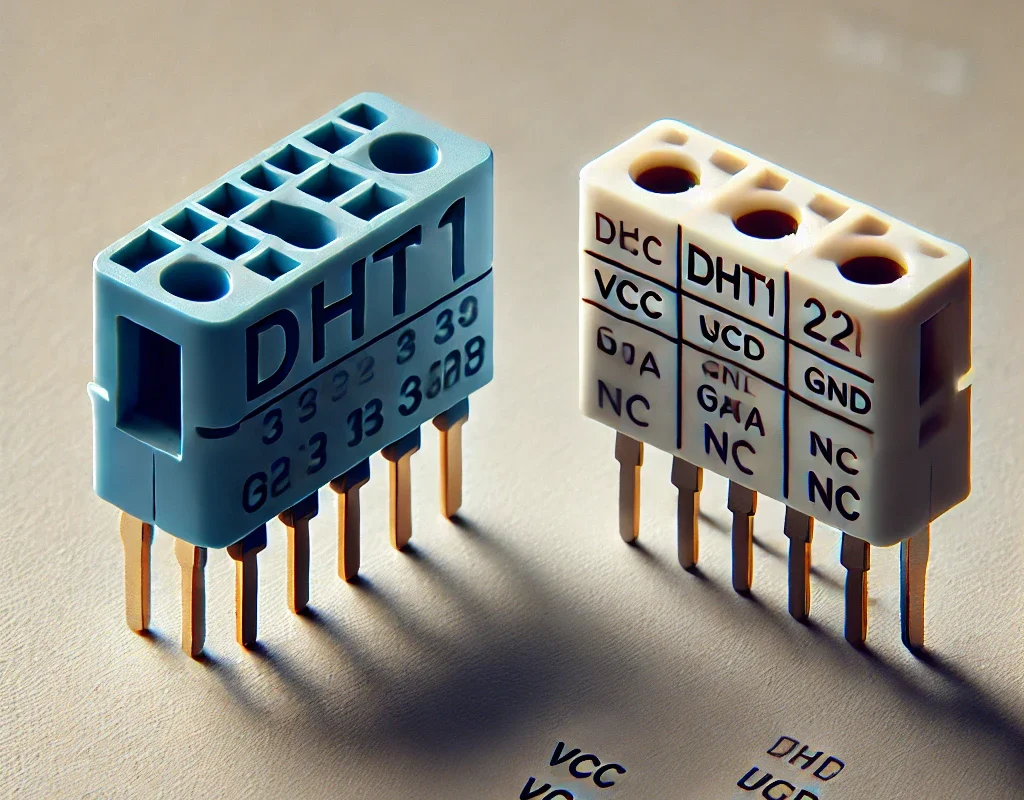
- Encapsulation: Typically blue or white plastic body, not suited for extreme conditions.
DHT22:
- Sensor Type: Capacitive humidity sensor and a thermistor, providing more stable and accurate readings.
- Encapsulation: White plastic body, slightly more robust against environmental changes compared to the DHT11.
3️⃣ Power and Interface
- Both sensors operate on 3.3V to 5V, making them compatible with most microcontrollers.
- Both use a single digital pin for communication via a proprietary protocol, which is not as standard as I2C or SPI, requiring specific library support.
4️⃣ Application Suitability
DHT11:
- Best for: Applications where coarse readings are acceptable, such as basic home environment projects or beginner electronics. It’s more economical, making it suitable for budget-sensitive applications and large deployments where high accuracy is not critical.
DHT22:
- Best for: More demanding applications requiring better accuracy and a wider range of temperature and humidity measurements. Suitable for outdoor environments or where conditions vary significantly, like greenhouses, weather stations, or high-performance data logging systems.
5️⃣ Price
- DHT22 is generally more expensive than the DHT11 due to its enhanced capabilities and better precision.
📊 Conclusion
Choosing between the DHT11 and DHT22 will depend on your specific project requirements. For hobby projects and learning applications, the DHT11 offers a cost-effective solution with reasonable accuracy. However, for more serious environmental monitoring or where extreme conditions are expected, the DHT22 provides better reliability, accuracy, and a broader operational range.
If precision, range, and robustness are key to your project’s success, the DHT22 is the better choice, albeit at a higher cost. On the other hand, for basic educational projects or indoor environments, the DHT11 will often suffice.